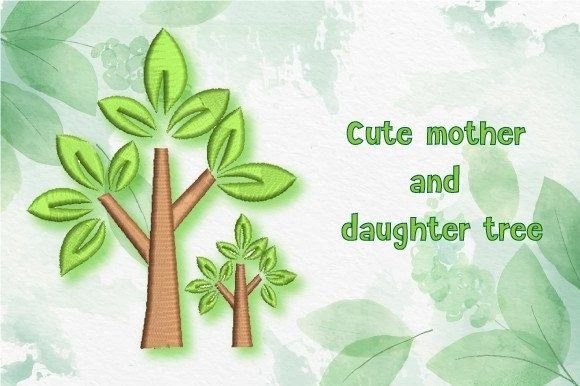
Cute Mother and Daughter Tree: A Designer’s Review
As an embroidery designer who has spent years digitizing patterns and reviewing thousands of machine embroidery design files, I have developed a keen eye for what works in the real world. It is one thing to see a crisp vector image on a screen; it is another entirely to watch those threads pull through fabric, dealing with tension, texture, and the limitations of the hoop. Recently, I evaluated the Cute Mother and Daughter Tree, a charming piece from the Forest category, to determine its viability for actual production. This is not just a digital asset; it is a potential centerpiece for a handmade product that needs to hold up under scrutiny.
First Impressions and Visual Narrative
The concept behind the Cute Mother and Daughter Tree is emotionally resonant. The design features two trees—one large, representing the mother, and one smaller, representing the child—positioned closely together. The description notes that "when they are born together, a mother will never leave her child." This narrative adds a layer of depth that goes beyond simple decoration. Visually, the layout is compact and organic. The shapes are soft, avoiding sharp, aggressive angles that can sometimes cause registration issues in embroidery.
For a designer, the immediate appeal lies in its versatility. The silhouette is distinct enough to be recognizable even at smaller sizes, yet detailed enough to carry visual interest on larger garments. The mood is warm, protective, and nurturing. This makes it an ideal candidate for projects where emotional connection is key, such as baby showers, Mother’s Day gifts, or family-themed apparel. However, aesthetic appeal is only half the battle. The true test is how these curves and connections translate into stitch data.
Real-World Application and Product Fit
I mentally placed this design on several common substrates to gauge its performance. My primary test case was a custom embroidered tote bag. Tote bags are staples for Etsy sellers and small shop product lines because they offer a large, flat canvas. The Cute Mother and Daughter Tree sits beautifully on canvas or heavy cotton. The organic lines of the trees complement the natural texture of the fabric. Because the design is likely composed of a mix of fill stitch for the foliage and potentially satin stitch or running stitch for the trunks, it should lay flat without excessive puckering, provided the stabilizer is chosen correctly.
Beyond totes, I considered this design for sweatshirt embroidery. A crewneck sweatshirt provides a cozy backdrop for this theme. Placed on the left chest, the design acts as a subtle badge of family love. If scaled up for the back, it becomes a statement piece. For baby embroidery, such as on a onesie or a receiving blanket, the scale must be reduced carefully. The charm of the design relies on the proximity of the two trees. If scaled down too much, the details might merge, losing the distinction between mother and child. Therefore, knowing the minimum viable size is crucial before committing to a personalized gift project.
Another strong use case is the embroidered patch. Patches are trending in boutique branding and custom apparel. This design’s self-contained shape makes it perfect for a merrowed edge or a satin border. It creates a cohesive unit that can be ironed or sewn onto denim jackets, caps, or backpacks. For holiday embroidery, particularly around Earth Day or family-centric holidays, this design offers a fresh alternative to traditional floral or heart motifs.
Technical Considerations and Stitching Challenges
While the design is visually appealing, practical execution requires attention to detail. One must consider stitch density. Trees with foliage often require dense filling to look lush. If the digitizer has packed too many stitches into a small area, the fabric may pucker, especially on thinner materials like jersey knits or silk blends. I always recommend testing the embroidery file on scrap fabric identical to your final project material. This allows you to adjust tension and check for any pulling that might distort the tree trunks.
Fabric choice is critical. On textured fabrics like terry cloth or fleece, fine details can get lost. The Cute Mother and Daughter Tree relies on the clear separation between the two forms. If the fabric pile is too high, the boundary between the mother tree and the daughter tree might blur. In such cases, using a cut-away stabilizer is non-negotiable to provide a firm foundation. For stretchy fabrics, such as those used in custom apparel like leggings or active wear, a stabilizer with elasticity or a heavy-duty cut-away is essential to prevent the design from warping after washing.
Color selection also plays a pivotal role. While greens and browns are the obvious choices for a forest theme, do not be afraid to experiment. A monochromatic look using varying shades of green can create depth without relying on complex color changes. Conversely, using contrasting thread colors for the trunk and leaves can enhance definition. I advise creating black and white mockups to check the contrast. If the design loses its shape in grayscale, it may lack sufficient definition in low-light conditions or when viewed from a distance.
Commercial Viability and Brand Consistency
For craft business owners and commercial embroidery professionals, the Cute Mother and Daughter Tree offers strong commercial potential. It taps into the evergreen market of family bonding and nature appreciation. However, professionalism is key. A sloppy stitch-out damages brand trust. Ensure that your machine is well-maintained and that needles are sharp to prevent thread breaks, which are more likely in dense areas of foliage.
When listing this as a digital embroidery file or selling finished items, transparency about the design’s limitations builds customer trust. Include care instructions that recommend gentle washing to preserve the integrity of the stitches. For printable mockup creation, show the design on various backgrounds to help buyers visualize the final product. This reduces return rates and increases buyer engagement.
It is also vital to confirm licensing terms. Before selling finished items or using this as a design asset in a larger collection, verify whether the license allows for commercial use. Some designers restrict the number of units you can sell, while others offer unlimited commercial rights. Ignoring this can lead to legal issues that jeopardize your small shop product line.
Final Verdict and Designer Notes
The Cute Mother and Daughter Tree is a thoughtful addition to any designer’s library. Its strength lies in its emotional resonance and adaptable shape. It performs well on sturdy fabrics like canvas, denim, and heavy cotton, making it ideal for tote bags, patches, and sweatshirts. Caution is advised when using it on thin or highly textured fabrics, where detail loss or puckering may occur.
- Test First: Always stitch out on scrap fabric to check density and tension.
- Stabilizer Matters: Use cut-away stabilizer for stretchy or thin fabrics to prevent distortion.
- Scale Carefully: Ensure the design is large enough to maintain the distinction between the two trees.
- Check Licensing: Confirm commercial rights before selling finished products or digital files.
- Contrast Check: Verify that thread colors provide enough contrast against the fabric background.
In conclusion, this design is more than just a pretty picture; it is a versatile tool for creating meaningful, high-quality embroidery project outcomes. With proper technical handling and thoughtful application, the Cute Mother and Daughter Tree can elevate your finished product and resonate deeply with your customers. It is a solid choice for designers looking to add warmth and narrative to their portfolio.